Self-Assessment Essay
Throughout the semester, we’ve explored various types of writing and texts to inspire ideas and writing styles to apply to our future essays. From Raymond Williams to Dick Hebdige, studying others’ definitions of culture across periods of time has had a huge impact on the way I think and how culture is defined by me and reflected through these texts. These then transitioned into our personal papers where we had projects with fellow classmates to discover what it meant to each of us translated into our writing.
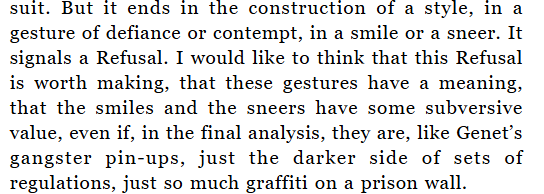
Excerpt from Hebdige
With a deep understanding of my progress throughout this semester through my writing and brainstorming, I’ve achieved the course learning outcomes to a great extent through my analysis of texts and composing my own narratives to enhance the flow of my writing. Each project went through a series of brainstorming worksheets, class discussions, and peer review to formulate the argument and development of the essay. Through these I grew a proficiency in analyzing and writing these genres that we were assigned for homeworks and took the time to breakdown and understand the difficult ones like Didion’s ‘Slouching Towards Bethlehem”. Then the casual tones of other texts like Foster Wallace’s ‘Consider the Lobster’ which is more informative and joyful in a way, exposing me to these vast genres that carry a similar overarching theme. Not only genres, but the rhetorical situations revolving around these stories are what keep me attached to details and refer back to them when I’m reflecting on class discussions regarding them. I found Consider the Lobster easier to read and understand compared to Bethlehem, but the message was stronger in the latter in respect to their stories. Through these small activities and required readings, I became attached to learning different writing styles and hence applied them in my larger projects.
In my Cultural Profile, I analyzed my peer Silvia’s culture through guided questions I asked her, and then connected the overall theme to texts we reviewed in class. As I got to know her over time, I found out that we had a lot of qualities in common like being close to family, enjoying music and finding passion in what we were studying. Having this common ground is what made the process successful and enjoyable. As we exchanged voice memos answering each other’s questions, it made me realize how important having turn-and-talk moments in class were to opening up and really networking was. I attended the writing center and took feedback from my peers to gather insight if I was following the guidelines of the assignment clear enough. I got to talk to the peers in my other classes to tell me more about things like cuisines, traditions and religious beliefs. I wouldn’t have expected something like this to occur from an English class but I’m glad it did. Because these themes were analyzed based on the texts we wrote, we had to apply them to our everyday lives and what we observe around us. This transitioned from free writes to the independent worksheets in class that had thought-provoking questions about what we observe. Then through this I adapted what I learned to how I drafted my profile and reached out to my peers and teachers for revisions.
Furthermore, the writing style and organization of these texts contribute to the success of my own with the use of necessary sources, summaries and methods of argumentation. In my subculture essay I introduced my idea with background information, followed by my stance and with specificity of what part of subculture I wanted to focus on. From there I created a flow into my essay of being authentic with what my personal experience in Jazz was to the facts and historics of it to create a pathway into pathos and logos. I quoted, “He mentions, “…each of these artists, in one way or another, makes reference back to mid-1970s jazz-r&b fusions, and each works in ways that interestingly disrupt not only genre boundaries, but also the expectations about the relationship to technology that have constituted those boundaries in the recent past”(26), a snippet of my research and what I took from it to detail an account of how modern music makes strong references to historic uses in music. This directly translates to my ability to research sources from sites such as Google Scholar, JSTOR and the CCNY Library which helped me find what I’m looking for in terms of my arguments and background information. It’s important that despite these websites proving as reliable, that doesn’t necessarily mean the papers are free from biases. Reading through the paper and the abstract helped me greatly to understand if the paper is citing facts or not, though a bit of opinion doesn’t hurt. As I go through the articles, I couldn’t help but notice a lot of them addressing how oppression and linguistic standards at those times actually empowered people to push towards fighting against them. I pointed this out the most throughout my Cultural experiment essay where I examined the rise of Afrofuturism and the way lyrics empowered those in the Black community to continue fighting for their rights and embrace who they are. They took Afro-inspired beats in their music and music videos which continued to trend in our current day.
As I wrap up the end of the semester, I’m grateful for the time I spent learning and writing in this class as I got to explore many genres and styles of writing and visually represent culture. Despite being named Writing for the Social Sciences, I took it as a class designed to make you critically think about how you approach everyday life.

