CULTURAL PROFILE: A Self-Profile
As Cynthia Burks had once said, “Culture doesn’t live in a place. It lives in our values.” After several readings, discussions, and journals, I’ve come to agree with that. A typical definition of culture that I’ve come to terms with for most of my life is ethnic culture: celebrations, religious ceremonies, and formal gatherings. Culture has been debated plenty, however, across the decades. So, have these interpretations helped or hurt our views on culture? The first step of diving deep into culture is to know the audience: people. People are the foundation of what culture comes to be, no matter what your viewpoint on it could be. Through that, I knew it was the time to settle to start Silvia and I’s interview,
I decided to settle on my living room couch for the interview to be as comfortable as possible. It’s been here ever since we moved, but the cover always changes. For this month, the cover was a cotton blue quilt with an intricate embroidered pattern in an antique orange color. To my opposite side is the hallway to the two bedrooms of the apartment, with my grandma on the phone standing in the doorway talking like her life depends on it. I settled in and timed my responses when there would be as little noise as possible in the room. For some questions, I needed to respond in the moment to keep the flow even though my grandma was fighting over the phone. Throughout our voice memos, she’d occasionally pick up through my microphone. Silvia was just coming off of work as well yet the space was very intimate for her to answer. Finding a sense of culture through familiar spaces was already a gateway into our discussion.
After exchanging formalities and introductions, I followed with the first question which is one of my favorites to ask. I turned back to my roots of my definition of traditional culture to question how traditions have grown with us across time, especially as college students now. That’s when I began to discover her definition of culture, being together in a community with people and embracing traditions.
“What’s a tradition you’ve kept alive from your childhood that you’ve brought into adulthood?”
“The typical foods that we make for holidays. Such as the desserts and the foods.
I definitely related to this; there’s always a selection that just reminds one of home and I’m a huge sucker for sweets. They’re like a form of therapy. Knowing that we shared a common ground was pretty neat!
“What’s one of your favorites?”
“Ponche is one of my favorites, it’s like a hot fruit punch. It’s mixed with a bunch of fruits and some cinnamon. If you go to a Mexican household they’ll definitely always have it. ”
Silvia was smiling from ear to ear when talking about it. I noticed that her comfortability with her ethnic culture was strong, which reminded me of my own and how something so simple as a sweet treat or a couch covering was a symbol of recognition.

It’s definitely one of those drinks that are perfect for the cold weather. I see why it’s one of her favorites just by looking at it and hearing what’s in it. What else besides food shapes her lifestyle? I think a big one we all can agree on is community, or where we live, who we live with and where we go and see people. School was a big one for her.
“How has your lifestyle shaped the way you are?”
“Growing up, I grew up with many different communities so that definitely helped me find out who I was and how to communicate with different people, even though we might not have had anything in common.”
She went to a predominantly white school, and then transferred into a more diverse school. It’s really amazing to me how such drastic changes in our lives lead us to sometimes finding what we want to do in the future! Silvia grew passionate about communications. But to my surprise, it wasn’t one of the first things she thought to study.
“Honestly, if you told me four years ago that I was gonna be studying communications now I wouldn’t believe you at all. I had so much social anxiety and I was literally that person that got anxiety when I got called to read or something like that, I just didn’t like public speaking at all.”
“Was there a moment that was a click to studying communications?”
“So my manager from my host job, I told him that I was studying business and he told me I don’t see you doing business. I see you doing something in communications because of how well you communicate with people. So after that I thought about it.”
“And so communications became my passion over the past year so after a lot of thinking, I decided to switch into communications and so far I really love it.”
It’s really great to hear how people come to what they study in school, because there’s (almost) always a heartwarming story behind it. But what’s more to culture than personal qualities? Your way of life. And remembering home with a symbol is a great way to define that! Sometimes it includes religion, and that applied to Silvia’s home.
“What’s a symbol in your home that reminds you that its “home” and why?”
“So a symbol that reminds me of home is loving Guadalupe, even though I’m not a religious person. I like her very much, mainly because my grandma was a really strong Christian, and she was always respectful about the fact that I didn’t really believe in religion. For me, she became like a big part of Mexican culture.”
Learning about Guadalupe was very interesting to me, especially how she’s represented in religion and in culture. I find these two go hand in hand and as someone who’s religious, figures are a great resemblance in homes to remember people and what they stand for. Silvia’s connection with her grandmother is very strong and I adore how respectful she was to her about it. It tells a lot about what Silvia’s culture is to her and how it’s important.
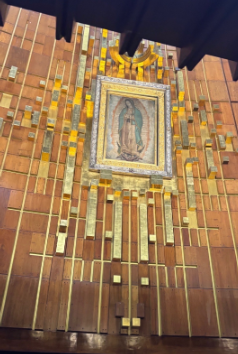
Catholicism carries a strong bond within the Mexican community and this video details a Chapel in its beauty and its symbolic figures. (definitely check it out!)
Culture and one’s way of life connects with one experience. These experiences can be good, bad, sad, traumatic, and happy and memorable. Everyone shares a different story and that’s what makes them who they are. Being able to reflect on it gives us a glimpse at who a person has become based on what they’ve been through. The simplest things that are still relevant as culture to us. Gratitude is a huge quality that the Hispanic community has, but this hospitality is blurred by our government and societal stigma that frame them as villains.
“Mexicans building a community is so important. If you go to Mexico everybody’s helping each other out you will see somebody that’s struggling to feed their family helping somebody else that’s less fortunate because that’s just how we are.” Silvia responded.
With our current administration, it’s clear how society encourages a division of community because of racism and stereotypes. James Baldwin reflects on this in “Stranger in the Village” where he says “The word ‘Negro’ in America carries a meaning which the Swiss villagers cannot possibly know. It is not a word of surprise; it is a word of hatred.”(171). Words are a weapon that is carried in America, and it’s used to create derogatory labels to ethnic groups. This is something that Baldwin details that is still relevant today. Silvia highlights the truth as someone who’s Latina is important to be exposed to her culture at its rawest.
Learning about how Silvia’s experiences and definitions of her life and personality come together to combine her culture was a great experience for me. It taught me many unexpected things and many truths that I’m glad were expressed. Rather than an interview, I’ll reinforce again, this was a conversation of intimacy and being ‘real’ which I appreciated greatly.
AI Transparency Statement
I, Tazneen Sultana, have used AI (Copilot) to assist me in the formulation of my Cultural Profile Final Draft. I have used it to summarize the provided texts, to help me cite my sources and to explain the rubric clearer in order to understand how to format my draft. However, I have in no way used it to directly write my cultural profile word for word. I firmly believed in straying away from this in order to maintain its authenticity. Thank you.


This is a comment on a news post! It will accept HTML code!
You can change you can post comments from the Dashboard > Settings > Discussion.
You can Edit/Delete comments from the Dashboard > Comments.
You can also turn off the Comments/Pingbacks on any Page or Post when you are editing a Page or Post from the Discussion section of the editor (usually below the field for the body).